The Ultimate India Experience-Golden Triangle tour with Varanasi
India is not a country you visit. It is a country that happens to you in colors, in sounds, in stories carved into stone, and in fire ceremonies reflected on sacred water.
Our golden triangle tour with Varanasi over 7 nights and 8 days is designed for travelers who refuse to rush. It connects four extraordinary cities Delhi, Agra, Jaipur, and Varanasi tour into a single journey that spans Mughal empires, Rajput kingdoms, and the oldest spiritual traditions known to humanity.
The classic golden triangle tour package delivers forts, palaces, and the immortal Taj Mahal. Adding Varanasi transforms the experience entirely. Suddenly, the journey is no longer just about what you see. It becomes about what you feel standing on ancient ghats as the Ganga Aarti fire rises into the night, drifting on a wooden boat at dawn while the holiest river in India catches the first light of a new day.
This 7N/8D itinerary gives you two full nights in Delhi, a night in Agra, two nights in Jaipur, and crucially two full nights in Varanasi. No rushing. No skipping. Every monument, every ceremony, and every moment of wonder gets the time it deserves.
A private car and dedicated driver accompany you across the Golden Triangle. A domestic flight carries you to the banks of the Ganges. And our team supports you 24 hours a day, 7 days a week-because in India, the best experiences often happen when you least expect them.
Your golden triangle tour with Varanasi starts with a warm welcome. Our driver meets you at Indira Gandhi International Airport or your Delhi hotel with a name sign, a cold bottle of water, and the quiet assurance that everything ahead has been arranged.
Check into your hotel. Let the jet lag dissolve under a hot shower and a cup of masala chai. Delhi can overwhelm the noise, the scale, the energy so today is about arriving gently.
If energy allows, take an evening walk through Connaught Place, Delhi's colonial era commercial heart. The circular colonnaded markets, the street food vendors, the blend of old and new it is your first taste of a city that has reinvented itself for a thousand years.
Overnight stay in Delhi.
Chapter One: Old Delhi. Your driver takes you into the winding lanes of Shahjahanabad the walled city built by the same emperor who built the Taj Mahal. Stand before the colossal Red Fort, its red sandstone walls stretching nearly two kilometers along the Yamuna River. Walk through the Jama Masjid, India's largest mosque, where the courtyard can hold 25,000 worshippers in prayer.
Stroll through Chandni Chowk, one of the oldest and busiest markets in Asia. The parathas at Paranthe Wali Gali have been fried in the same style since the 1870s. The spice market fills the air with turmeric, cardamom, and dried chili.
Chapter Two: New Delhi. The car enters the tree-lined avenues designed by Edwin Lutyens. Drive past India Gate the war memorial arch honoring soldiers of World War I. See the grandeur of Rashtrapati Bhavan (Presidential Palace) and Parliament House.
Visit Humayun's Tomb the magnificent 16th-century Mughal garden tomb that directly inspired the Taj Mahal. This UNESCO World Heritage Site is often called the "Taj before the Taj," and its symmetry and serenity deserve every minute you give it.
End the day at Qutub Minar, the tallest brick minaret in the world. Twelve centuries of Delhi's layered history are carved into its fluted sandstone walls.
Overnight stay in Delhi.
Early breakfast. The car turns south onto the Yamuna Expressway a smooth 3-to-4-hour drive that builds anticipation with every kilometer.
And then you see it.
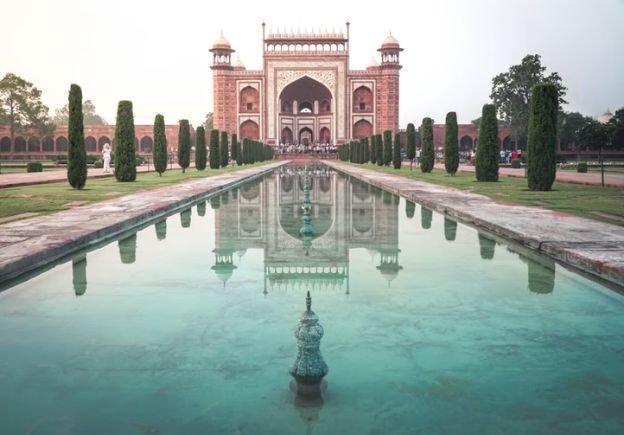
The Taj Mahal does not simply appear. It reveals itself first as a ghostly silhouette glimpsed through the great sandstone gateway, then in full breathtaking glory as you walk closer across the reflecting pools. Emperor Shah Jahan built it between 1632 and 1653 as an eternal monument of love for his queen Mumtaz Mahal. Nearly four centuries later, it remains the most beautiful building human hands have ever created.
Take your time. Lean close to see the pietra dura semi-precious stones (jasper, jade, turquoise, lapis lazuli, coral) inlaid into white Makrana marble with surgical precision. Watch how the marble changes color blush pink at sunrise, radiant white at noon, warm amber at sunset.
After lunch, visit Agra Fort, a massive UNESCO World Heritage fortress of red sandstone. Walk through the Diwan-i-Khas (Hall of Private Audience) and stand at the Musamman Burj the octagonal tower where Shah Jahan spent his final imprisoned years, gazing endlessly across the Yamuna at the tomb he built for his beloved.
For an unforgettable optional experience, visit Mehtab Bagh at sunset the garden directly across the river that offers a reverse-angle view of the Taj Mahal reflected in still water. Most tourists never see this perspective.
Overnight stay in Agra.
Morning begins with a 40 kilometer drive to Fatehpur Sikri, Emperor Akbar's 16th century capital city. Built with imperial ambition, abandoned after just 14 years allegedly because the water ran dry this ghost city stands frozen in time, perfectly preserved.
Walk through the Buland Darwaza (Gate of Magnificence), the tallest gateway in all of Asia at 54 meters. Visit the sacred tomb of Salim Chishti, where intricate marble lattice screens glow in the sunlight and visitors tie threads and whisper wishes they dare not speak aloud.
The road turns west toward Jaipur. Five hours through the Rajasthani countryside the landscape transforming from green Yamuna plains to the sun-baked beauty of Rajasthan. Dusty villages appear and vanish. Camel carts share the highway with painted trucks. In winter, fields of bright yellow mustard flowers stretch to every horizon.
Arrive in Jaipur by late afternoon. The evening is yours wander the legendary Johari Bazaar and Bapu Bazaar, overflowing with gemstones, block-printed fabrics, blue pottery, mojari shoes, and traditional Rajasthani handicrafts.
End with a rooftop dinner overlooking the illuminated Pink City skyline your first night in Rajasthan's capital.
Overnight stay in Jaipur.
Today belongs entirely to Jaipur and Jaipur gives like a royal host.
Begin at the Amber Fort, perched on a hilltop overlooking the shimmering Maota Lake. Ride up by jeep along the winding path once traveled by elephants carrying Rajput kings. Inside, the Sheesh Mahal (Mirror Palace) creates an indoor galaxy thousands of tiny convex mirrors embedded in walls and ceiling, reflecting a single candle flame into a constellation of stars.
Descend to the city center for the Hawa Mahal the Palace of Winds with its iconic honeycomb facade of 953 small windows. Designed so that royal women could observe street processions and daily market life without being seen by the public below, it remains one of the most photographed facades in all of India.
Continue to the City Palace, a stunning fusion of Rajasthani and Mughal architecture, still partially occupied by descendants of the royal family. The Mubarak Mahal and Diwan-i-Khas house exquisite collections of royal garments, weapons, manuscripts, and palanquins.
Next, step into Jantar Mantar, the 18th-century astronomical observatory built by Maharaja Sawai Jai Singh II. Home to the world's largest stone sundial accurate to within two seconds this UNESCO World Heritage Site feels like science fiction carved in stone.
An optional sunset visit to Nahargarh Fort rewards you with sweeping panoramic views the entire city spread below in shades of rose and terracotta, the Aravalli hills rippling to the horizon.
Overnight stay in Jaipur.
This is the day the journey transforms.
A morning flight from Jaipur to Varanasi takes approximately 1.5 to 2 hours. You leave behind the palaces and forts of Rajasthan. You land in the oldest continuously inhabited city on Earth a city where death is not mourned but celebrated, where the sacred and the everyday are indistinguishable, where the Ganges River carries prayers, ashes, and flower petals toward eternity.
The shift hits you immediately. The air smells of sandalwood incense and marigold garlands. Temple bells ring from unseen shrines down narrow medieval lanes barely wide enough for two people to pass. Cows, motorbikes, pilgrims, and sadhus with ash-smeared foreheads share the same cobblestone paths.
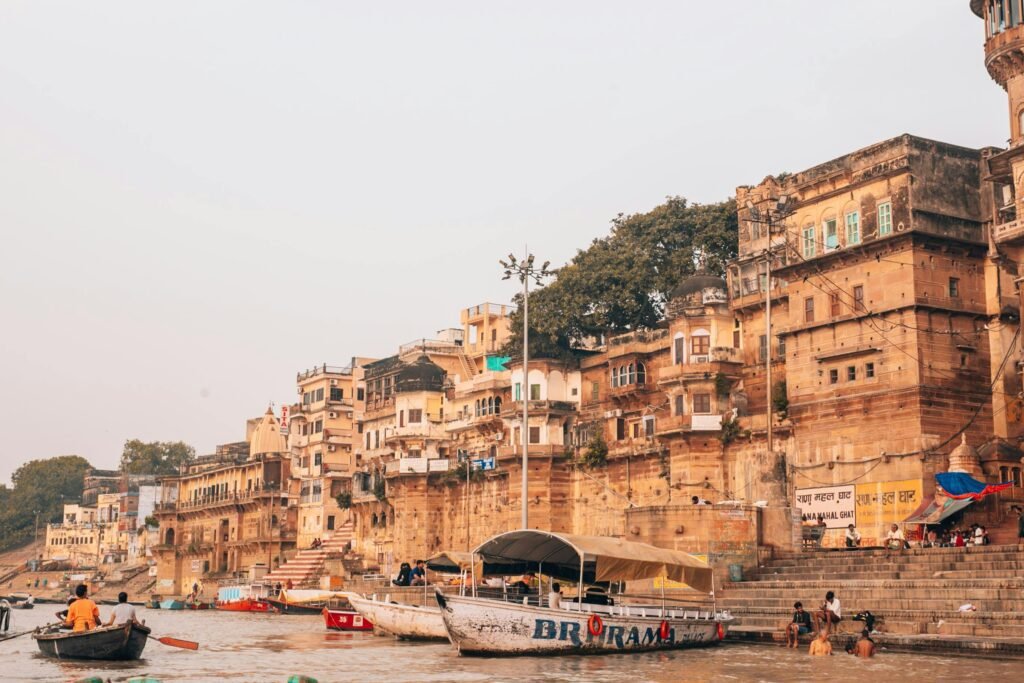
After checking into your hotel preferably one overlooking the ghats the afternoon is devoted to walking the riverfront ghats of Varanasi. Eighty-four stone staircases descend into the Ganges along a five-kilometer stretch. Walk from Assi Ghat to Manikarnika Ghat, passing yogis in meditation, families performing rituals, children flying kites, and smoke curling upward from pyres that have burned continuously for over 3,000 years.
As evening descends, make your way to Dashashwamedh Ghat for the event that defines this city the Ganga Aarti ceremony. Seven priests stand on elevated platforms, wielding large brass lamps blazing with fire, moving in synchronized rhythm as Sanskrit chants echo across the river. Thousands gather — on the steps, in boats, along rooftops. Small leaf boats carrying flower petals and tiny oil flames are set adrift on the Ganges. The boundary between the sacred and the spectacular dissolves entirely.
This is the moment travelers remember for the rest of their lives.
Overnight stay in Varanasi.
Wake before dawn. This is non-negotiable because a sunrise boat ride on the Ganges is not something you experience from a hotel balcony.
Your boatman rows gently along the river as the first pale light appears on the eastern horizon. The ghats awaken pilgrims performing morning ablutions waist-deep in the water, yoga practitioners saluting the rising sun on stone platforms, dhobis slapping laundry against ancient steps. At Manikarnika Ghat, cremation fires that have burned without interruption for three millennia send smoke into the pink morning sky.
The city is golden. The river is glass. The silence on the water despite a city of millions on the shore is profound.
Return to shore and visit the Kashi Vishwanath Temple one of the 12 sacred Jyotirlinga shrines of Lord Shiva and the spiritual nucleus of Varanasi. Its gold-plated spire donated by Maharaja Ranjit Singh catches the morning sun like a beacon visible from the river.
After a leisurely breakfast, the afternoon takes you 10 kilometers northeast to Sarnath one of the four holiest sites in Buddhism. This is where Lord Buddha delivered his first sermon (the Dhammacakkappavattana Sutta) after achieving enlightenment at Bodh Gaya. The Dhamek Stupa, a massive cylindrical stone structure, marks the exact spot.
Visit the Sarnath Archaeological Museum, which houses the original Lion Capital of Ashoka the four-lion sculpture that became India's national emblem. See the ancient monastery ruins, the Ashoka Pillar, and the Bodhi tree grown from a sapling of the original.
Return to Varanasi in the late afternoon. The evening is free revisit the ghats, explore the silk weaving workshops of Banaras (where legendary Banarasi silk sarees are handwoven on wooden looms), or simply sit on the steps of a quiet ghat and watch the river carry the last light of the day downstream.
An optional second evening of Ganga Aarti this time from a boat on the river offers a completely different, equally moving perspective.
Overnight stay in Varanasi.
A final morning in Varanasi. If you wish, one more early walk along the ghats the light will be different today, and so will you.
After breakfast, transfer to Lal Bahadur Shastri International Airport for your departure flight to Delhi or your onward destination.
Eight days. Four cities. Mughal emperors. Rajput warriors. Marble mausoleums. Pink palaces. Sacred rivers. Eternal fire. The scent of marigolds. The sound of temple bells. The silence of a boat on the Ganges at dawn.
Your golden triangle tour with Varanasi ends here but what India has given you travels home permanently. In photographs, yes. But more than that in a shift of perspective, a widening of the heart, a memory that glows like the Ganga Aarti flame every time you close your eyes.
The golden triangle with Varanasi route is a year-round journey, but each season adds its own layer of beauty.
October to March is the peak season and for good reason. Temperatures across all four cities are cool and comfortable. Varanasi’s ghats are most atmospheric in crisp winter mornings, and the Ganga Aarti ceremony under clear night skies is transcendent. The Taj Mahal in soft winter light glows with a warmth no photograph can fully capture. Book 3–4 weeks in advance during this period.
April to June brings intense heat. Temperatures in Agra, Jaipur, and Varanasi regularly exceed 40°C. However, crowds vanish, hotel rates drop significantly, and early-morning sightseeing remains comfortable. Budget-conscious travelers and heat-tolerant adventurers find this period rewarding.
July to September is the monsoon season. Rain transforms the landscape Jaipur’s Aravalli hills turn emerald green, the Ganges swells with monsoon water, and the Taj Mahal seen through light rain is hauntingly beautiful. The Ganga Aarti continues every single evening, rain or shine.
Festival tip: If your dates align with Dev Deepawali (November) in Varanasi when one million oil lamps illuminate every ghat along the Ganges in a cascade of golden light book immediately. It is among the most spectacular sights in all of India, and our spiritual Varanasi tour during this festival is our most requested itinerary.
This route is offered by hundreds of operators across India. Here is why thousands of travelers choose us year after year, trip after trip.
A Decade of Mastery. We have designed and operated golden triangle tour packages including Varanasi extensions of every duration for over ten years. Our drivers know every highway shortcut, every scenic rest stop, and every hidden viewpoint that guidebooks overlook.
Truly Private. No shared buses. No group itineraries. No strangers’ schedules dictating your day. Your car, your driver, your pace. Want to spend three hours at the Taj Mahal instead of one? Done. Want an extra hour at Dashashwamedh Ghat? No one is waiting.
Varanasi Done Right. Many operators compress Varanasi into a rushed overnight stop arrive late, wake early, leave quickly. We give you two full nights in the holy city. The Ganga Aarti. The sunrise boat ride. Sarnath. The silk workshops. The old city lanes. Varanasi reveals itself slowly and our 7N/8D itinerary gives it the time it demands.
Verified by Travelers. Our tours are rated 4.9 out of 5 across Google and TripAdvisor. Travelers from 40+ countries have trusted us with their India experience and taken the time to share their stories publicly.
Transparent Pricing. The quote we provide is the price you pay. Every inclusion is listed. Every exclusion is stated. No ambiguity. No post-booking surprises.
Rooted in India. We are based in Agra the very heart of the Golden Triangle. We don’t operate from a distant office in another country. We live where the Taj Mahal stands. This land is our home, and sharing it with travelers is our calling.
The 7N/8D itinerary is designed for travelers who want depth, not speed. Unlike shorter 5-day versions, this duration allows a full day for Delhi sightseeing (Old Delhi AND New Delhi), a full day in Jaipur without rushing, and most importantly two complete nights in Varanasi. You experience the evening Ganga Aarti AND the sunrise boat ride on separate, unhurried mornings. You visit Sarnath without sacrificing ghat time. Every city breathes.
The most popular option is a direct domestic flight from Jaipur to Varanasi approximately 1.5 to 2 hours. This maximizes your time in Varanasi. Alternatively, an overnight AC train offers a budget-friendly, authentically Indian experience you sleep on the train and wake up on the banks of the Ganges. We arrange whichever option matches your preference, schedule, and budget.
Varanasi adds a dimension that no other city on the india golden triangle tour route can offer raw, ancient spirituality. The Ganga Aarti at Dashashwamedh Ghat is an overwhelming multisensory ceremony of fire, chant, and devotion. The sunrise boat ride on the Ganges offers a perspective on life, death, and faith that no monument can replicate. And Sarnath where Buddha delivered his first sermon provides a profoundly moving encounter with 2,500 years of spiritual history.
Absolutely. The private car format ensures comfort at every stage. In Varanasi, some walking on uneven ghat steps is involved, but we arrange boat access from convenient points and cycle-rickshaw transfers through narrow lanes to minimize physical strain. The 7N/8D pacing is especially well-suited for older travelers no day is rushed. Kid-friendly hotels and adjusted activity schedules are available for families. The Amber Fort jeep ride and Varanasi boat ride are particularly popular with children and grandparents alike.
Yes every element is flexible. Add a Ranthambore tiger safari between Jaipur and Varanasi (extends to 9N/10D). Include Khajuraho and its UNESCO-listed temple sculptures. Extend to Lucknow for Awadhi cuisine and Mughal architecture. Upgrade any hotel. Add professional guide services at every monument. Schedule a sunrise Taj Mahal visit or a cooking class in Jaipur. Share your interests and we build the perfect itinerary around you.
Modest clothing is recommended covered shoulders and knees for both men and women. Remove shoes before entering any temple (carry a small bag for them). Light, breathable cotton or linen fabrics work best in Varanasi's humidity. For the sunrise boat ride, carry a light shawl or jacket pre-dawn temperatures on the river can feel cool, even in warm months. Comfortable walking shoes with good grip are essential for the steep, sometimes wet ghat steps.
With Us, choosing your next escape is easy. We curate destinations that mix beauty, relaxation, and culture in one trip.

Joy of colors in The City Of Taj

A Rare Natural Wonder with Blush-Toned Sand
White Sands and Turquoise Waters Away from the Crowds
Iconic cliffs, blue waters, panoramic beauty.
Famous for its white sand and turquoise beauty.
Famous for its white sand and turquoise beauty.
Famous for its white sand and turquoise beauty.
Trip to Taj Mahal (A unit of Indian Impression) is a Travel and Destination Management Company in India, which designs and operate tours covering the requirements of the travelers.